Zoho One: A Complete Guide for Artificial Intelligence Professionals
Architecture & Design Principles Zoho One is organized as a suite of tightly integrated services rather than a monolith. Key design choices include multi-...
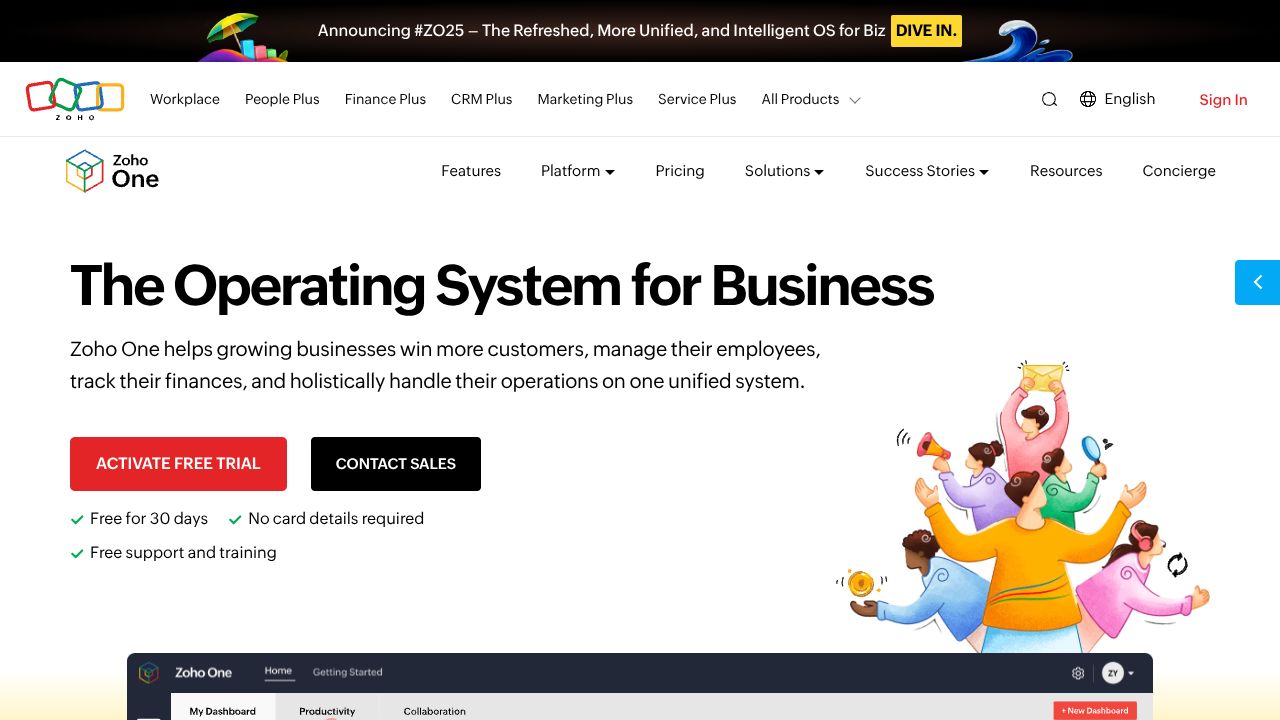
1 in 3 companies would kill for a single-pane admin — and Zoho One basically sells you that pane
Teams waste an average of 5 hours per week context-switching between disconnected apps. Zoho One is an AI-driven, all-in-one business suite packing 50+ apps (CRM, Books, People, Desk, Projects, and more) under one subscription. Technically it’s an API-first, multi-tenant SaaS bundle with a centralized admin plane, built around Zoho’s Zia AI for embedded analytics and automation. Design philosophy: consolidate functionality, minimize integration friction, and push governance to a single control plane (identity, provisioning, billing, device management). As someone who juggles five tabs and a paper crane while writing, I appreciate the "fewer moving parts" promise — when it works, the operational overhead actually goes down.
Architecture & Design Principles
Zoho One is organized as a suite of tightly integrated services rather than a monolith. Key design choices include multi-tenancy for cost efficiency, an API-first surface (REST/JSON), and per-app microservice boundaries for independent scaling. Identity and access are centralized (SSO/SAML/OAuth2 support, role-based access), with tenant-level provisioning and the All-Employee licensing model simplifying entitlement management. Data consistency is handled through service contracts and event-driven patterns (webhooks/queues) to sync CRM → Books → Desk workflows without synchronous coupling. For AI, Zia acts as a platform layer that consumes telemetry and business data to provide embedded analytics, recommendations, and anomaly detection. The end result: SaaS-grade scalability with operational controls tuned for SMBs and mid-market enterprises.
Feature Breakdown
Core Capabilities
- ○
Feature 1: CRM (Sales)
Technical explanation: CRM exposes REST APIs, webhook triggers, and automation rules. It supports workflow engines that execute server-side business logic (custom functions, deluge scripts) and integrates with Books and Desk via event buses.
Use case: Auto-create invoices in Books when a deal closes, with webhook-driven propagation and idempotency checks to prevent duplicates. - ○
Feature 2: HR (People)
Technical explanation: People provides employee lifecycle APIs, role-based data partitioning, and HR workflows (onboarding, approvals) backed by centralized identity. Data is versioned for audit trails and HR reports leverage ETL pipelines into the analytics layer.
Use case: Provision cloud accounts and MDM enroll devices for new hires automatically during onboarding. - ○
Feature 3: Helpdesk & Projects (Desk & Projects)
Technical explanation: Ticketing and project modules expose real-time APIs and webhook subscriptions. Desk uses routing rules, SLA engines, and integrates with chatbots (Zia) for triage. Projects supports timesheets and task dependencies with export APIs for BI ingestion.
Use case: Route urgent tickets to on-call engineers, create linked project tasks, and surface SLA breaches into a monitoring dashboard.
Integration Ecosystem
Zoho One offers a broad integration surface: native connectors for common services, REST APIs, webhooks, and an integration platform (Zoho Flow) for low-code automations. For enterprise needs, it supports SAML/SCIM provisioning, OAuth2-based OAuth flows, and can be fronted by an API gateway for centralized logging and rate-limiting. Third-party connectors exist for Slack, Microsoft, Google Workspace, and payment gateways — enabling hybrid stacks without full migration.
Security & Compliance
Data is tenant-isolated with role-based access controls and centralized admin policies. Zoho supports SSO (SAML/OAuth2), SCIM for user provisioning, and MDM for mobile endpoints. Audit logs and activity trails are available for governance; Zoho publishes compliance attestations (SOC/ISO/other regional certifications depending on product/region). For regulated workloads, data residency options and encryption-at-rest/in-transit are standard considerations.
Performance Considerations
Because it’s a multi-tenant SaaS, peak-load planning is abstracted away, but you still must watch API rate limits and background job latencies. Event-driven syncs introduce eventual consistency — design integrations with idempotency and reconciliation in mind. The embedded analytics are near-real-time for dashboards, but heavy BI queries should be exported to data warehouses to avoid throttling.
How It Compares Technically
If you need a single vendor bundle at low cost, Zoho One beats patchwork stacks on TCO. For deep platform extensibility, compare their architectures vs. Microsoft Dynamics 365 (https://learn.microsoft.com/en-us/dynamics365/) and Salesforce Platform (https://www.salesforce.com/products/platform/overview/) which offer more mature enterprise middleware, extensive partner ecosystems, and platform-as-a-service capabilities. If you prefer open-source modularity, Odoo’s developer docs (https://www.odoo.com/documentation/15.0/developer/) show how to self-host and extend at the code level — something Zoho doesn’t expose as openly.
Developer Experience
Docs are practical and API-driven, with SDKs for common languages and low-code builders (Deluge, Flow). The community is smaller than Salesforce’s, but responsive. Expect solid REST endpoints and webhook coverage; advanced customizations sometimes require creative use of platform scripting rather than full runtime control.
Technical Verdict
Strengths: exceptional TCO, centralized governance, vast native app coverage, and embedded AI for SMB-friendly automation. Limitations: less raw PaaS-level extensibility than Salesforce/Dynamics, eventual consistency constraints for cross-app processes, and governance trade-offs for enterprises needing deep customization. Ideal for companies that want to license broad employee access cheaply and move fast without building an integration layer. My hot take: if your org values velocity and budget over hyper-customized platform engineering, Zoho One is a pragmatic, technically sound bet — just design integrations with idempotency and observability from day one.
External Reference
Visit Zoho One →