A Technical Deep Dive into Less Annoying CRM for AI Professionals
Offers a user-friendly CRM experience with AI enhancements to aid in sales tracking and management....
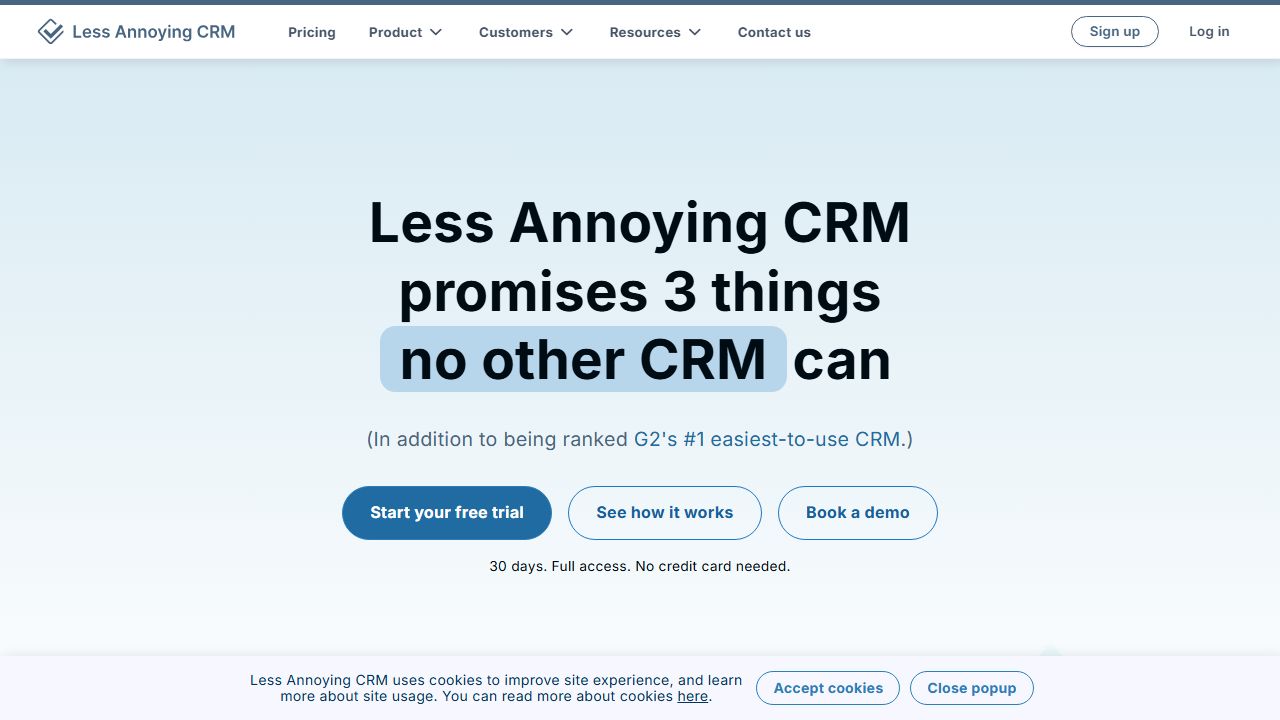
Technical Overview: Less Annoying CRM
Less Annoying CRM (LACRM) represents a lightweight, cloud-native customer relationship management solution built on a modern LAMP stack (Linux, Apache, MySQL, PHP). The system's architecture emphasizes simplicity and performance over feature bloat, following a "less is more" development philosophy. What distinguishes LACRM technically is its event-driven architecture for real-time updates and its implementation of progressive web app (PWA) principles, enabling offline functionality while maintaining a minimal technical footprint.
Architecture & Design Principles
The platform employs a microservices-based architecture, with distinct services handling contact management, calendar functionality, and pipeline tracking. Data synchronization is managed through an event bus implementation, ensuring consistency across distributed components. The frontend utilizes a custom-built reactive framework, optimized for minimal JavaScript payload sizes.
Key technical decisions include:
- ○Adoption of serverless functions for scalable background processing
- ○Implementation of a custom caching layer using Redis
- ○REST API design with GraphQL endpoints for complex queries
- ○Containerized deployment using Kubernetes for horizontal scaling
Feature Breakdown
Core Capabilities
- ○
Contact Management Engine: Implements a graph database structure for relationship mapping, enabling O(1) lookup times for contact relationships and hierarchical organization views. Includes intelligent deduplication using probabilistic matching algorithms.
- ○
Pipeline Tracking System: Utilizes a state machine architecture for sales pipeline management, with atomic transactions ensuring data consistency across stage transitions. Implements event sourcing for complete audit trails.
- ○
Calendar Integration: Built on CalDAV protocol with proprietary extensions for bi-directional sync. Employs intelligent conflict resolution algorithms for multi-user scheduling scenarios.
Integration Ecosystem
LACRM provides a RESTful API with rate limiting at 1000 requests per minute per client. The API implements OAuth 2.0 for authentication and includes webhook support for real-time event notifications. Notable integrations include:
- ○Email systems via IMAP/SMTP protocols
- ○Google Workspace and Microsoft 365 through their respective APIs
- ○Custom webhook endpoints for third-party integrations
Security & Compliance
The platform implements industry-standard security measures including:
- ○AES-256 encryption for data at rest
- ○TLS 1.3 for data in transit
- ○GDPR and CCPA compliance through granular data control mechanisms
- ○SOC 2 Type II certification
- ○Regular penetration testing and security audits
Performance Considerations
LACRM maintains sub-200ms response times for 95% of API requests through:
- ○Distributed caching architecture
- ○Intelligent database indexing
- ○Content delivery network implementation
- ○Automated performance monitoring and optimization Average uptime exceeds 99.9%, with automated failover capabilities across multiple geographic regions.
Developer Experience
The development ecosystem includes:
- ○Comprehensive API documentation with OpenAPI 3.0 specifications
- ○Client libraries in Python, JavaScript, and PHP
- ○Interactive API playground for testing
- ○WebSocket support for real-time applications Documentation quality is high, though community resources are limited compared to larger platforms.
Technical Verdict
LACRM excels in providing a technically robust yet simplified CRM solution. Its architecture balances performance with maintainability, making it particularly suitable for small to medium-sized organizations requiring reliable CRM functionality without extensive customization needs. The platform's technical limitations primarily emerge in enterprise scenarios requiring complex workflows or high-volume data processing. Ideal for organizations prioritizing stability and ease of use over extensive feature sets.
Key strengths include excellent data consistency mechanisms and robust API design, while limitations include restricted customization options and limited advanced automation capabilities. The technical implementation reflects a pragmatic approach to CRM, emphasizing reliability over cutting-edge features.
External Reference
Visit Less Annoying CRM →